
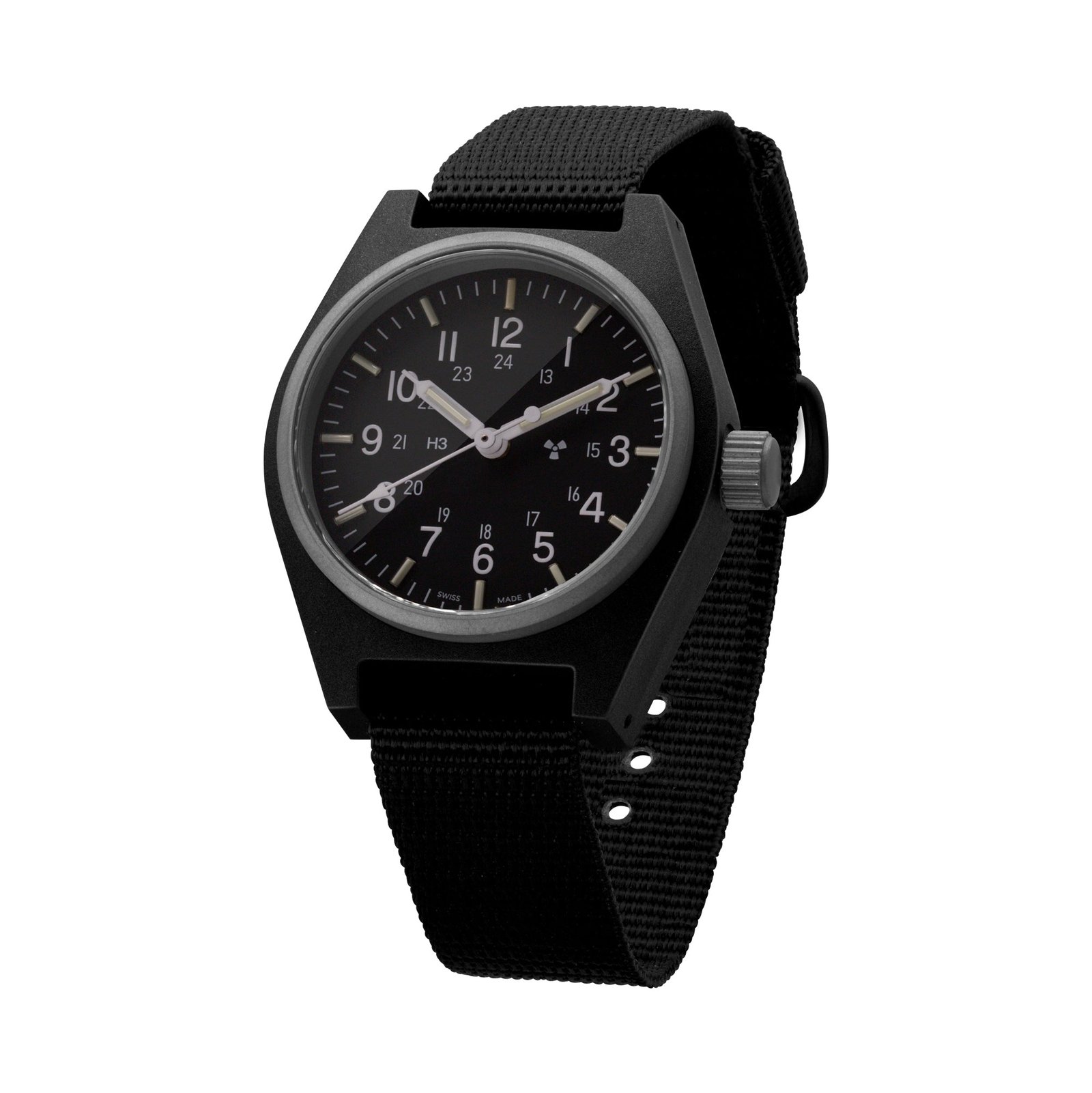
The Marathon General Purpose Quartz (GPQ) is one of those field watches that feels more like equipment than jewelry. It’s small, light, and built around a simple goal: be readable, be tough, and be easy to live with.
Brand overview: Want the bigger picture? See Marathon Field Watches: what to know + best picks (brand guide + alternatives).
Important: Marathon has multiple “General Purpose” references (case materials, lume type, date/no-date, straps). The specs below match the current 34mm composite-case GPQ listing, but always verify the exact reference you’re buying.
At a glance
- What it is: compact military-style field watch with a Swiss quartz movement.
- Why people buy it: set-and-forget accuracy, utilitarian legibility, and true all-night visibility via tritium tubes (on tritium variants).
- Watch out for: multiple references/eras with different specs (especially crystal, water resistance, and lume type).
Specs (quick sheet)
- Case: 34mm high-impact composite fibreshell (current GPQ composite reference)
- Diameter: 34mm
- Lug-to-lug: 41mm
- Thickness: 11.5mm
- Lug width: 16mm
- Water resistance: 3 ATM (30m) — think rain / hand-washing, not swimming
- Crystal: sapphire (current listing)
- Movement: ETA high-torque FØ6 quartz (3-jewel) with EOL (end-of-life) indicator
- Lume: tritium gas tubes (current tritium GPQ listing)
- Crown: pressure (push/pull)
If you’re new to the category, start here: What is a field watch? and how to choose a field watch.
Common variations to watch for (shopping checklist)
- Tritium vs paint lume: some GP models use tritium tubes, others use painted lume (“Maraglo”).
- Date vs no-date: both exist. Make sure the dial layout matches what you want.
- Case material: composite fibreshell vs steel versions (weight and feel differ a lot).
- Crystal: current listing is sapphire, but always confirm (older/other military-style watches are sometimes acrylic).
- Water resistance: don’t assume; confirm the exact rating and treat it conservatively.
On-wrist comfort (small-watch advantages)
The big story with the GPQ is wearability. A 34mm case and short lug-to-lug can be a feature: it stays out of the way, doesn’t hang over the wrist, and works better as a true “grab-and-go” daily beater.
If you’re shopping specifically for compact field watches, this guide helps: best field watches for small wrists.
Dial & legibility (what it’s like day-to-day)
Marathon dials lean hard into function: clear Arabic numerals, a straightforward minute track, and an instrument-like layout. In practice, the question is less “is it pretty?” and more “can I read it instantly at a glance?”—which is exactly what you want from a field watch.
Lume (tritium in real life)
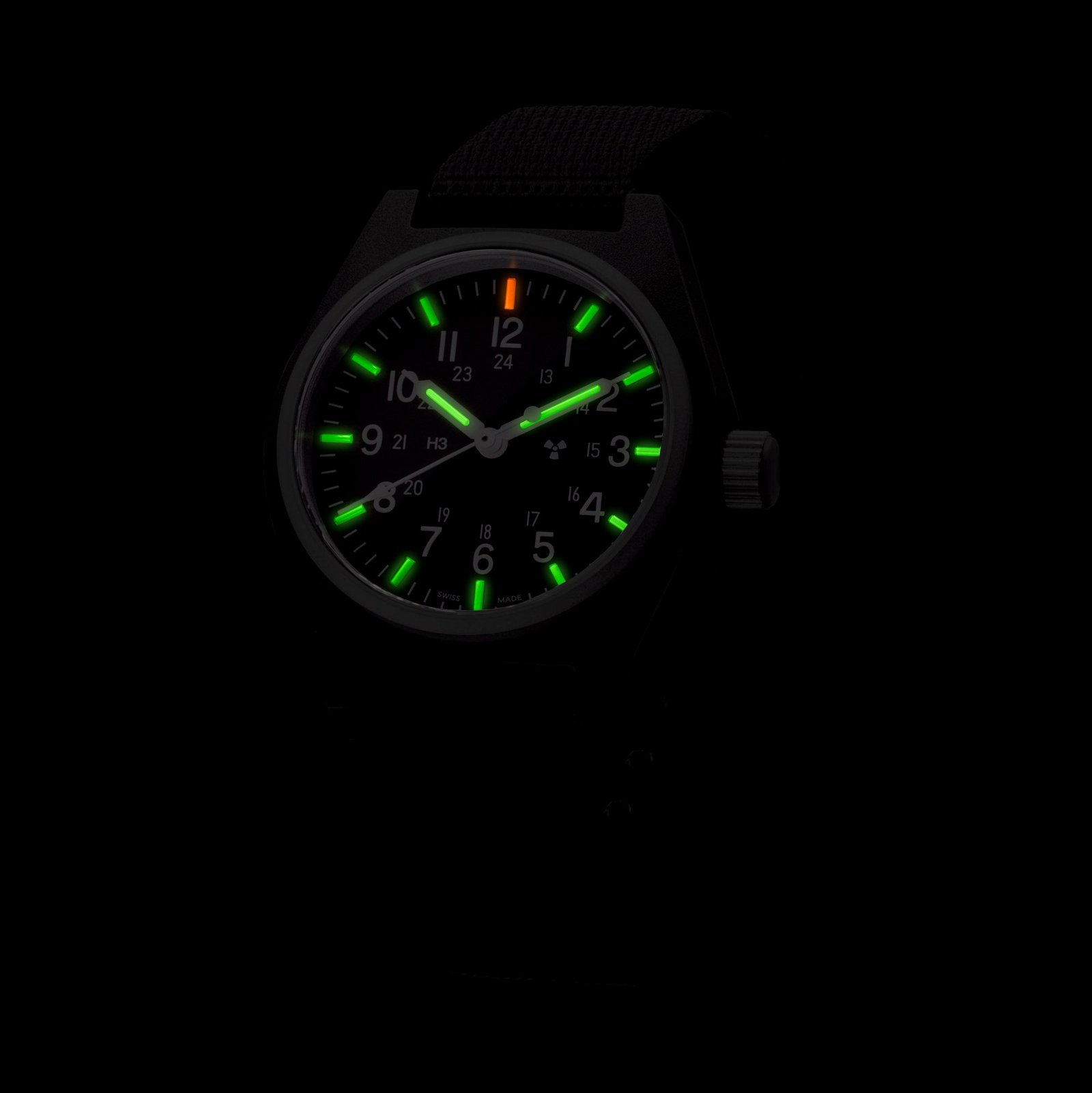
If your GPQ reference uses tritium tubes, the benefit is consistent night visibility without needing to “charge” the watch first. The tradeoff is that it’s typically more of a steady, always-there glow than a short-lived blast of brightness—and tritium gradually dims over many years.
If night readability matters for camping/hiking use, you’ll probably also like: best field watches for hiking & camping.
Movement notes (why quartz makes sense here)
Quartz is a great match for a true field beater: accurate, low maintenance, and (usually) more forgiving of daily knocks than many budget automatics. Marathon’s high-torque ETA FØ6 movement is also commonly listed with an EOL indicator—a handy feature that signals the battery is running low.
If you’re deciding between quartz/auto/solar: field watch movements explained.
Water resistance & durability (set expectations)
On the current listing, the GPQ is rated to 3 ATM (30m). That’s usually fine for rain and hand-washing, but it’s not a “take it swimming” watch. Water resistance also depends on seals + age + crown habits—not just the printed number.
Guide: 30m vs 50m vs 100m water resistance (what it really means). Also: field watch vs dive watch.
Straps: the easiest way to tailor the feel
With 16mm lugs, strap choice matters. A simple NATO/single-pass style keeps the vibe military (but adds thickness under the case), while a thin two-piece strap keeps it compact and light.
Start here: best straps for field watches and NATO vs Zulu vs single-pass.
Pros & cons
Pros
- Compact, comfortable fit (especially on smaller wrists)
- Quartz convenience (accurate, low maintenance)
- Very tool-ish, high-legibility dial design
- On tritium variants: true all-night visibility without charging
Cons
- Easy to buy the “wrong” version if you don’t verify the exact reference/specs
- Small size won’t suit everyone
- 3 ATM WR (on the current listing) limits it to light water exposure
- 16mm lugs can feel limiting if you like chunky straps
Alternatives (and when to pick them)
- Bertucci A-2T — rugged, practical, and often a better “value beater” if you want a sturdier case.
- Timex Expedition North Field Post Solar — solar convenience with a more modern spec set for the price.
- Seiko 5 Sports Field SRPG27 — for an affordable automatic with a field-style dial (more maintenance than quartz).
- Bulova Hack — for a vintage military vibe (and if you prefer mechanical).
- Hamilton Khaki Field Mechanical — the upscale mechanical option with strong brand support.
Who it’s for
- You want a true beater that prioritizes function and comfort.
- You prefer quartz practicality over the romance of an automatic.
- You have a smaller wrist or simply like compact watches.
- You want always-on night legibility (on tritium versions) more than “bright for 10 minutes” lume.
Quick FAQ
Is the Marathon GPQ “worth it”?
It can be, if you value military-style legibility and you specifically want the Marathon approach (often tritium + a strict utilitarian build). If you mainly want the look, cheaper watches get you a lot of the vibe for less.
Can you swim with it?
On the current 3 ATM listing: no, I wouldn’t treat it as a swimming watch. If you’re considering a different reference with a higher WR rating, still be conservative unless you’ve verified seals/condition.
Price & value (what you’re paying for)
Marathon pricing can look high next to generic “field-style” watches, but it’s not trying to be a fashion piece. What you’re really buying is a specific formula: a purpose-built dial, a no-nonsense case, and (on many versions) tritium tubes that stay visible all night without charging.
If you just want the look, there are cheaper options. If you want the Marathon execution, the GPQ is one of the more approachable entry points—especially if you’re fine with the smaller 34mm footprint and you’ll treat the 3 ATM water resistance conservatively.
Battery life & maintenance (what to expect)
One underrated advantage of a quartz field watch is that maintenance is predictable: replace the battery when needed, check gaskets during a battery change, and you’re basically done. If your GPQ has an EOL (end-of-life) indicator, you’ll usually get a clear warning (often a “jumping” seconds hand) before it actually dies—so it’s unlikely to surprise you mid-trip.
For long-term durability, the habits matter more than the marketing: keep the crown pushed in, avoid hot showers/steam, and don’t assume a rating equals real-world waterproofing forever.
Where to buy (Amazon)
- Amazon (US): Search “Marathon General Purpose Quartz watch”
Verdict
The GPQ makes a strong case as a compact, no-fuss field beater: light on the wrist, easy to read, and very low maintenance. The main caveat is reference variation—so the “smart buy” is the one where you confirm lume type, water resistance, and crystal before you click “checkout.”