
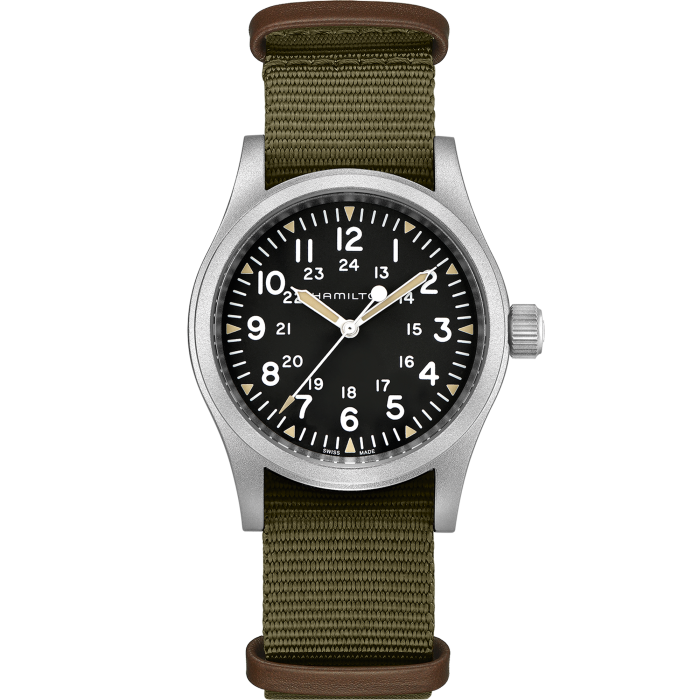
If you ask watch people to name a “real” field watch you can actually buy today, the Hamilton Khaki Field Mechanical comes up almost every time. That’s not because it’s rare, expensive, or complicated. It’s the opposite: it’s straightforward, military-inspired, easy to wear, and backed by a brand that’s been building tool watches for a long time.
Brand guide: For the bigger Hamilton overview + best picks, see Hamilton field watches: what to know + best picks.
Watch photos (official)
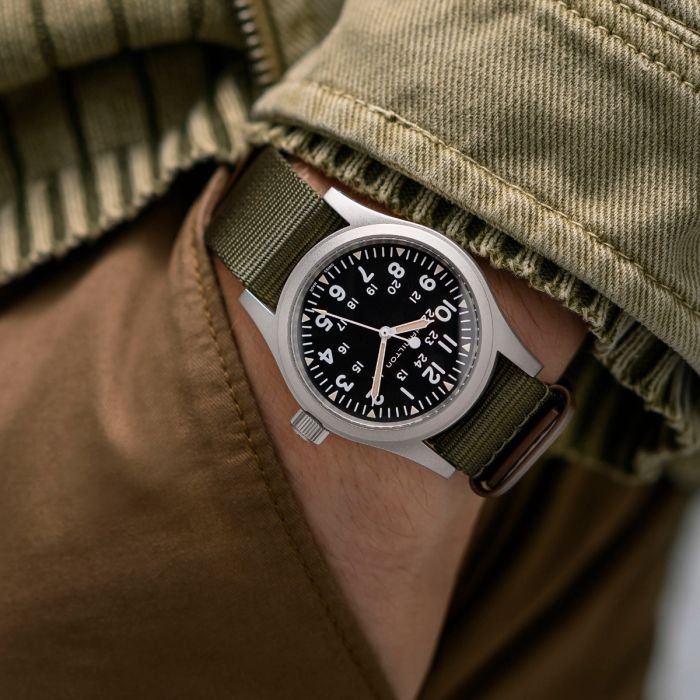
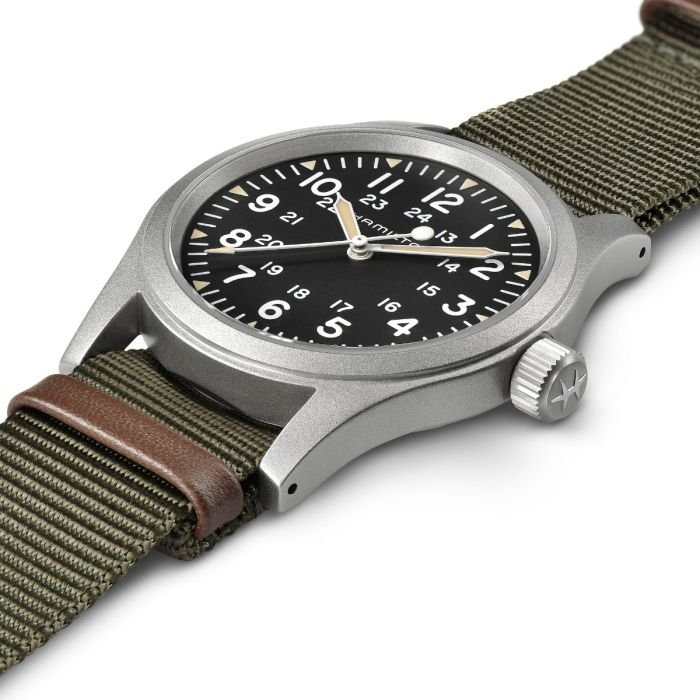
This review focuses on the popular 38mm Khaki Field Mechanical with Hamilton’s hand-wound H-50 movement. Below: a practical spec sheet, what it’s like on wrist, where it’s strong, where it’s limited, and a few genuinely good alternatives.
Bottom line: if you want a compact, legible, manual-wind field watch that works on almost any strap, this is the modern benchmark. The two main “gotchas” are the 50m water resistance and whether you actually enjoy winding a watch.
Specs (quick sheet)
- Case: 38mm stainless steel
- Lug-to-lug: ~47mm (varies slightly by reference)
- Thickness: ~9.5–10mm (varies by crystal/reference)
- Lug width: 20mm
- Water resistance: 50m
- Crystal: typically sapphire on current production (verify your exact reference)
- Movement: Hamilton H-50 (hand-wound), ~80-hour power reserve
Note: specs can vary by exact reference and production year. Always confirm details (crystal, AR coating, strap/bracelet, dial color, etc.) on the product page for the reference you’re buying.
On-wrist (size, comfort, daily wear)
38mm sounds small on paper, but in field-watch terms it’s a sweet spot. It sits flat, avoids overhang on smaller wrists, and still reads clearly at a glance. The relatively slim profile also means it doesn’t feel top-heavy on thicker straps (canvas, NATO, leather).
If you’re unsure about sizing in general, the site’s field watch size guide is a useful baseline (36–42mm isn’t “better/worse,” it’s mostly about wrist shape and how you plan to wear the watch).
Dial design & legibility
The dial layout is classic field watch: bold Arabic numerals for the main hour track, a smaller 24-hour inner track, and a simple minute railroad. In real use, it’s exactly what you want from the category—fast to read without thinking about it.
Set expectations appropriately: this is a tool-watch dial, not a glossy luxury dial. The matte, purposeful finishing is part of why it works so well as an everyday beater.
Movement (why hand-winding is the point)
The H-50 is a hand-wound movement with an advertised ~80-hour power reserve. The number itself is nice, but the real value is the interaction: this is a “ritual watch.” You put it on, you wind it, you go. If you like the idea of a mechanical watch because it feels alive (and you don’t mind a tiny daily habit), that’s the appeal.
If you want maximum convenience (set-and-forget), you’ll probably prefer an automatic, quartz, or solar option. This guide may help you choose the right direction: Field watch movements (quartz vs automatic vs manual vs solar).
Lume
The Khaki Field Mechanical’s lume is generally usable for quick checks in low light, but it’s not a dedicated “lume monster.” The watch prioritizes daytime legibility and a clean military-inspired look over thick, high-surface-area lume plots.
If night visibility is a major buying criterion for you, consider comparing it against alternatives with larger lume application (see below) or using it with realistic expectations: it’s a field watch first, a night-time beacon second.
Water resistance & durability
50m water resistance is fine for day-to-day life (rain, hand washing, occasional splashes). I wouldn’t treat it as a worry-free swimming watch. If “I can jump in a pool and not think about it” matters, 100m is a safer baseline.
If you want a clearer mental model for ratings, see: Water resistance explained (30m vs 50m vs 100m).
Straps (20mm lug width = endless options)
The 20mm lug width is one of the most practical parts of the watch—there are endless strap choices, and strap changes are where the Khaki Field Mechanical becomes your watch. A few easy directions:
- NATO / Zulu / single-pass: best for the classic military vibe and comfort. (Guide: NATO vs Zulu vs single-pass)
- Canvas: great for outdoors use and sweat resistance.
- Leather: instantly makes it feel more vintage / city-friendly.
If you want quick recommendations, here’s a curated list: Best straps for field watches.
Pros & cons
Pros
- Benchmark legibility with a classic field-watch dial layout.
- 38mm wears well on a wide range of wrists.
- Hand-wind is engaging (and the long reserve keeps it low-drama).
- Strap-friendly 20mm lugs with endless options.
Cons
- 50m water resistance is fine for daily wear, but not ideal if you want a true swim-capable beater.
- Hand-winding isn’t for everyone (convenience buyers should look elsewhere).
- Inner 24-hour track is authentic, but some people prefer a cleaner dial.
Alternatives (worth cross-shopping)
- Seiko 5 Sports Field SRPG27 — automatic, value-focused, and a very easy “daily” field-style option.
- Timex Expedition North Field Post Solar — solar convenience for people who want set-and-forget practicality.
- Bulova Hack Watch — a classic military-inspired look with a different wrist feel and personality.
- Formex Field Automatic — a more premium-feeling take if you want a modern tool watch with extra refinement.
If you’re shopping by budget, start here: Best field watches under $300 and best field watches under $1,000.
Who it’s for
This watch is for someone who wants a single “real” mechanical field watch that’s wearable, reputable, and not precious. If you want a compact daily tool watch and you like the idea of a small winding ritual, it’s a safe anchor for a small collection.
Related reading
- Hamilton vs Seiko vs Timex: best field watch for you
- How to choose a field watch (10-point checklist)
- Best field watches for hiking & camping
Where to buy
Availability and pricing change—double-check the exact reference and the seller before buying.
Disclosure: Some links may be affiliate links. See our Affiliate Disclosure.
6 thoughts on “Hamilton Khaki Field Mechanical 38mm Review (H-50)”
Comments are closed.