
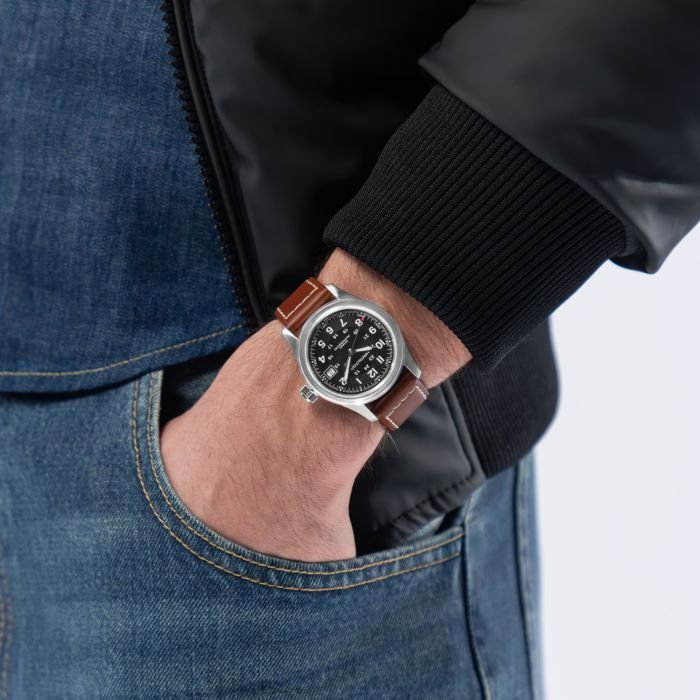
The Hamilton Khaki Field Automatic is one of the most “default good” picks in modern field watches: classic military-inspired legibility, a reliable automatic movement (Hamilton’s H-10), and enough water resistance to treat it like a real daily watch.
Brand guide: For the bigger Hamilton overview + best picks, see Hamilton field watches: what to know + best picks.
Watch photos (official)
These are official product photos from Hamilton for the Khaki Field Auto family (example reference: H70455533). Details can vary by size/variant—use them to visualize the overall design.
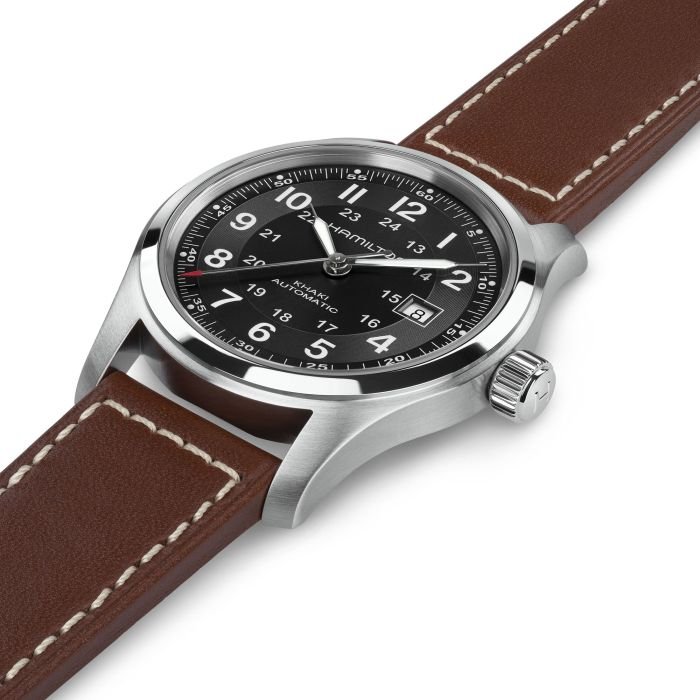
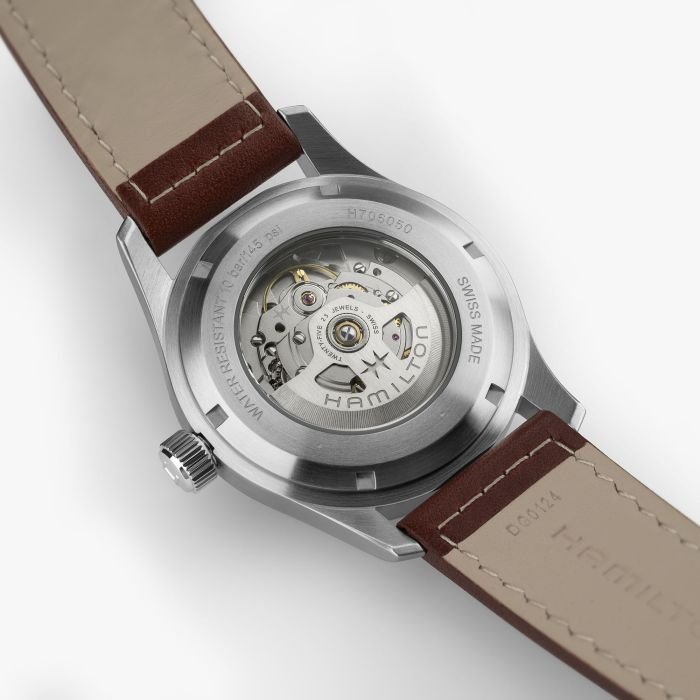
If you like the vibe of the Khaki Field Mechanical but want an easier everyday watch (no winding, longer power reserve, usually a slightly more robust feel), the Automatic is the obvious next step.
At a glance
- What it is: Swiss-made field-style automatic with Hamilton H-10 movement.
- Why people buy it: “One watch” versatility: office → weekend → travel.
- Watch out for: Reference/size variations (38 vs 42) change the wrist feel more than you’d expect.
Specs (typical listings — verify your exact reference)
Hamilton has multiple sizes/variants. Treat the numbers below as a starting point and confirm the exact spec sheet for your reference before buying.
- Case: Stainless steel
- Diameter: commonly 38mm or 42mm (depending on variant)
- Lug-to-lug: typically mid-to-high 40s (varies by size)
- Thickness: typically around ~11mm (varies by size / crystal / caseback)
- Lug width: often 20mm on 38mm variants; larger variants may be 22mm
- Water resistance: commonly listed at 100m
- Crystal: Sapphire (often with anti-reflective coating)
- Movement: Hamilton H-10 automatic (commonly listed ~80-hour power reserve)
- Complications: typically time + date (variant-dependent)
- Caseback: often exhibition/display (variant-dependent)
- Crown: typically push/pull — verify details for your exact reference
If you’re trying to decide whether 38mm or 42mm will actually fit, the Field Watch Size Guide and Best Field Watches for Small Wrists are the quickest ways to sanity-check lug-to-lug and thickness against watches you already own.
Common variations to watch for (shopping checklist)
Hamilton’s lineup has lots of small reference-level differences. Before you buy, it’s worth double-checking these details for the exact model you’re looking at:
- 38mm vs 42mm (and lug width): this decides comfort and which straps you can reuse. Many 38mm variants are commonly 20mm lugs; larger cases may be 22mm.
- Strap vs bracelet reference: bracelet versions often wear heavier and read a bit dressier; strap versions lean more classic field.
- Dial details: some variants use faux-patina lume or different numeral/hands styling—small changes that make it feel more vintage or more modern.
- Caseback: exhibition vs solid (and the thickness difference it can bring).
- Date window details: placement/contrast can vary; if dial symmetry matters, confirm photos of your exact reference.
- AR coating: some are listed with anti-reflective coating, but not always consistently across variants—worth confirming if glare bothers you.
On-wrist: how it wears (and which size makes sense)
The biggest “mistake” people make with the Khaki Field Automatic is choosing the size based on diameter alone. In real life, lug-to-lug and thickness do most of the work in how a watch feels.
- 38mm: The safest all-around pick if you want a classic field-watch footprint.
- 42mm: Better if you want more dial presence or have a larger wrist — but it can feel less “vintage field.”
Dial & legibility
This is Hamilton’s superpower: clean numerals, high-contrast hands, and a layout that’s easy to read at a glance. If you’re new to the category, What Is a Field Watch? explains why this kind of dial design is the whole point.
Movement: H-10 in plain English
The H-10 is essentially Hamilton’s “modern everyday automatic” movement: it’s designed for long power reserve and low-fuss ownership. The key practical win is that you can take the watch off Friday night and it’s often still running Monday morning (depending on how much power it had when you set it down).
If you’re still deciding between quartz/solar and mechanical, read Field Watch Movements: Quartz vs Automatic vs Manual vs Solar for the trade-offs.
Lume
Lume varies by dial color and variant. Expect it to be functional (finding the time in a dark room) rather than a “dive watch beacon.” If lume is a top priority, it’s worth checking real photos/video for the exact reference you want.
Water resistance (and what 100m actually means)
Most Khaki Field Automatic variants are commonly listed at 100m water resistance, which is usually enough for rain, showers, and swimming — assuming gaskets are in good condition and the crown is properly secured. For the nuance, see Water Resistance Explained.
Straps & bracelets
This watch is a strap monster. A simple strap change can swing it from “office casual” to “trail watch” instantly. Start here:
Buying notes (quick checklist)
- Decide 38mm vs 42mm up front: diameter is the headline, but lug-to-lug + thickness decide comfort. If you’re on the fence, start with the Field Watch Size Guide and sanity-check against watches you already own.
- Confirm lug width before ordering straps: many 38mm variants are commonly 20mm; larger variants may use 22mm. If you’re building a strap rotation, this matters as much as the case size. (See: Best Straps for Field Watches.)
- Know what “field watch” you want: the Khaki Field Automatic sits right in the middle — more refined than a pure beater, but still outdoors-friendly. If you’re cross-shopping categories, read Field Watch vs Dive Watch.
- Shopping value: at MSRP it can feel expensive for a simple three-hander, but it’s often a strong buy on sale/used. If you’re price-sensitive, compare against the lists in Best Field Watches Under $500 and Best Field Watches Under 300 to make sure you’re paying for the things you actually care about.
Pros & cons
Pros
- Classic field-watch legibility with a “nice watch” finish
- Modern automatic movement with long power reserve (typically ~80h)
- Versatile: works on leather, NATO, canvas, bracelet
Cons
- Lots of reference variations → easy to buy the “wrong” size/strap setup
- Lume is good-to-okay, not the main selling point
- Can be pricey at MSRP (often better value on sale or used)
Alternatives (and when to pick them)
- Hamilton Khaki Field Mechanical (H-50) — if you want the most “pure” field-watch feel (manual wind) and don’t mind winding.
- Formex Field Automatic — if you want a more modern, feature-rich take (and a different design language).
- Seiko 5 Sports Field SRPG27 — a solid, affordable automatic “field style” option with lots of variants.
- Bulova Hack Watch — if you want vintage military vibes and a great dial for the money.
- Vaer C3 Solar — if you like the field-watch look but want set-and-forget solar practicality.
- Bertucci A-2T — if you want a tough, lightweight beater you won’t baby.
Still unsure? The Hamilton vs Seiko vs Timex comparison is the fastest way to pick the right “lane.”
Who it’s for
- You want one watch that can do almost everything without looking tactical.
- You like the idea of an automatic, but don’t want “fragile boutique” vibes.
- You care about legibility and comfort more than hype.
Verdict
If you want a field watch that doesn’t feel like a compromise — legible, comfortable, and “nice enough” for everyday life — the Khaki Field Automatic is a safe recommendation. The only real catch is the amount of variation across references: once you choose the right size and strap/bracelet setup for your wrist, it’s easy to live with.
- Pick 38mm if you want the classic field-watch proportions, wear smaller watches, or just prefer comfort over presence.
- Pick 42mm if you want more dial presence or have a larger wrist — but expect it to feel less “vintage field” and more modern everyday watch.
If you’re still unsure which direction to go, the Hamilton vs Seiko vs Timex comparison will usually make the choice obvious.